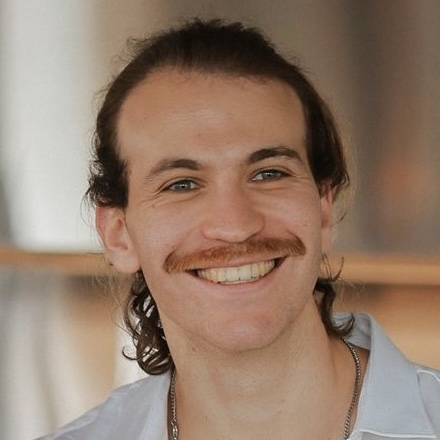
Ido Nitzan Hidekel

Ph.D. direct-track student at Tel Aviv University (Geometric Deep Learning Lab) · Lead, Deep Learning at Dtect Vision.

I study the foundations of deep learning — spectral bias, optimization dynamics, and generalization. My central question is how neural networks learn at different frequencies, and what that means for real-world learning problems. I treat learned representations as signals, characterize how training dynamics absorb and amplify spectral content, and use that lens to design principled methods.

The frequency-domain view connects problems that look unrelated. Two of the applications I focus on are detection of AI-generated audio, where the high-frequency residuals networks struggle to learn become a discriminative signal, and continual learning and catastrophic forgetting, where spectral analysis of representation drift exposes what is lost during training and what can be preserved.

At Dtect Vision I lead the deep learning group, translating these insights into production-grade detection systems. Academically, I am advised in the Geometric Deep Learning Lab, working on spectral-bias-aware optimization, frequency-guided representations, and the broader theory of how networks learn.

Prior: B.Sc. in Applied Mathematics and M.Sc. in Electrical Engineering (signal processing track), both at Tel Aviv University. I moved into the direct Ph.D. track after completing my M.Sc. thesis work.

Foundations of deep learning Spectral bias Optimization dynamics Generalization Frequency-domain learning Continual learning & forgetting Synthetic-media detection
News latest first
May 2026
SONAR accepted to ICML 2026! Code, figures and findings on the project page · GitHub · arXiv:2511.21325.
Apr 2026
Transitioned to the Ph.D. direct track at Tel Aviv University, continuing in the Geometric Deep Learning Lab.
2026
Appointed Lead, Deep Learning at Dtect Vision, heading research and productization of detection systems for generated audio/image media.
Nov 2025
Preprint released: SONAR — Spectral-Contrastive Audio Residuals for Generalizable Deepfake Detection (arXiv:2511.21325).
2025
Joined Dtect Vision (R&D) to work on production deepfake detection — translating frequency-domain theory into deployable detectors.
2024
Started M.Sc. in Electrical Engineering (signal processing track) at TAU; joined the Geometric Deep Learning Lab as a deep learning researcher.
2024
Completed B.Sc. in Applied Mathematics, Tel Aviv University.
Selected Publications * denotes equal contribution · see Scholar for all

SONAR: Spectral-Contrastive Audio Residuals for Generalizable Deepfake Detection

Ido Nitzan Hidekel, Gal Lifshitz, Khen Cohen, Dan Raviv
Accepted to ICML 2026 · arXiv preprint, Nov 2025

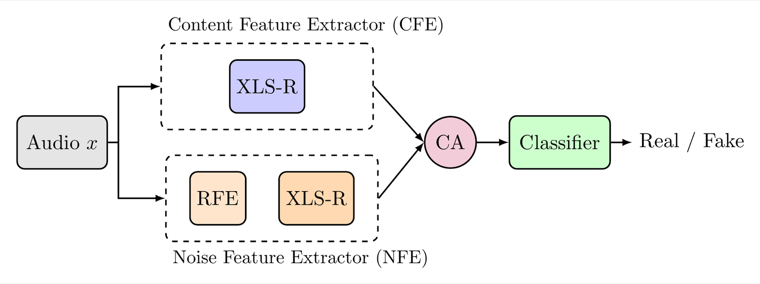
Neural networks preferentially learn low frequencies, which both leaves high-frequency artifacts in generated audio and leaves those artifacts under-exploited by common detectors. SONAR is a dual-path framework that learns data-driven SRM-style filters to isolate high-frequency residuals and uses a Jensen–Shannon contrastive objective to pull real content/noise pairs together and push fake pairs apart in latent space, yielding strong generalization to unseen generators.

spectral bias audio deepfakes contrastive learning SRM residuals cross-generator generalization

More preprints in preparation — on frequency-aware optimization and generalization in detection models.

Experience & Educationcurrent & past

Experience

Lead, Deep Learning · Dtect Vision

2025–present · Tel Aviv
  • Lead the deep learning group working on detection of AI-generated audio and images.
  • Translate theory on spectral bias and frequency-domain behavior into production detectors.
  • Build large-scale training/evaluation pipelines on GCP; own model architecture, loss design, and evaluation protocol.

Deep Learning Researcher · Geometric Deep Learning Lab, TAU

2024–present
  • Research on spectral bias, optimization dynamics, and frequency-aware representation learning.
  • Designed frequency-guided detection frameworks for generative artifacts (SONAR, 2025).
  • Developing follow-up work on generalization of detectors under distribution shift.

Education

Ph.D., Electrical Engineering (direct track)

Tel Aviv University · 2026–present

Foundations of deep learning: spectral bias, optimization dynamics, generalization, with applications to synthetic-media forensics.

M.Sc., Electrical Engineering (thesis track)

Tel Aviv University · 2024–2026 · GPA 95.5

Signal processing track. Complementary coursework in random signals & noise, signal processing, and control theory (GPA 98).

B.Sc., Applied Mathematics

Tel Aviv University · 2020–2024

Coursework in probability, statistics, optimization, stochastic processes, numerical methods, and machine learning.

Research Agendain brief

Frequency-domain view of learning

How neural networks differentially absorb low- vs. high-frequency structure across training, and why the spectrum a model can represent is the spectrum it tends to learn.

Optimization dynamics & generalization

How optimizer choice, parameterization, and loss geometry shape spectral trajectories during training, and how those trajectories predict downstream generalization.

Continual learning & forgetting

Spectral signatures of catastrophic forgetting: which frequency bands of a learned representation drift first, and what spectrally-aware interventions preserve plasticity without sacrificing stability.

Synthetic-media detection

Frequency-residual methods for detection of AI-generated audio and image content, with an emphasis on cross-generator generalization and robustness under deployment shift.

CV & Contactget in touch

Curriculum vitae

Full CV with coursework, skills, and timeline:

Download PDF →

Technical

PyTorch · Lightning · Torch DDP · Python / NumPy / Pandas · Docker · GCP · CNNs · encoders · generative models · loss design · ablations & reproducibility.

Contact

Email · Idonithid@gmail.com
Scholar · Ido Nitzan Hidekel
LinkedIn · ido-nitzan-hidekel
GitHub · @idonithid

Collaboration

Happy to discuss projects on frequency-domain analysis of neural networks, deepfake detection, or applied detection problems grounded in signal processing. Reach out by email.